
PDF Download Soft Soil, Black Grapes: The Birth of Italian Winemaking in California (Nation of Nations), by Simone Cinotto
PDF Download Soft Soil, Black Grapes: The Birth of Italian Winemaking in California (Nation of Nations), by Simone Cinotto
The options of the words, dictions, as well as just how the writer communicates the message and lesson to the visitors are very understandable. So, when you really feel bad, you may not assume so tough regarding this book. You could delight in as well as take a few of the lesson provides. The everyday language usage makes the Soft Soil, Black Grapes: The Birth Of Italian Winemaking In California (Nation Of Nations), By Simone Cinotto leading in experience. You can discover the means of you to earn proper statement of reviewing design. Well, it's not an easy difficult if you really do not like reading. It will certainly be even worse. However, this publication will certainly lead you to feel various of just what you can feel so.
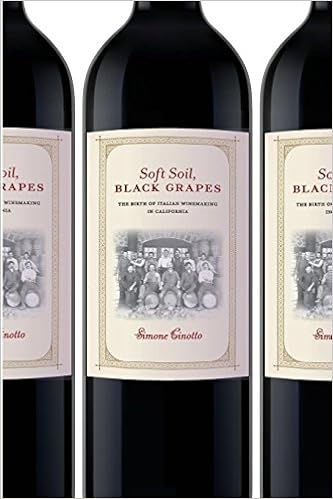
Soft Soil, Black Grapes: The Birth of Italian Winemaking in California (Nation of Nations), by Simone Cinotto

PDF Download Soft Soil, Black Grapes: The Birth of Italian Winemaking in California (Nation of Nations), by Simone Cinotto
There are so many publications that can be prospects to read in this recent period. Nonetheless, it may be impossible for you to review as well as complete them at the same time. To overcome this trouble, you must pick the very first book as well as make plans for other books to read after finishing. If you're so baffled, we suggest you to select Soft Soil, Black Grapes: The Birth Of Italian Winemaking In California (Nation Of Nations), By Simone Cinotto as your analysis resource.
This reason is among some reasons that make lots of people mostly wish to read this publication. It is likewise advised with the better of exactly how the author shows the description, offering examples, and chooses the dictions. Every word as well as sentence that is included in pack as a publication qualified Soft Soil, Black Grapes: The Birth Of Italian Winemaking In California (Nation Of Nations), By Simone Cinotto appears in extremely enhancing condition. This is not only for the analysis product however likewise a god selection for reading.
Beginning with seeing this site, you have tried to start caring reviewing a publication Soft Soil, Black Grapes: The Birth Of Italian Winemaking In California (Nation Of Nations), By Simone Cinotto This is specialized site that offer hundreds compilations of publications Soft Soil, Black Grapes: The Birth Of Italian Winemaking In California (Nation Of Nations), By Simone Cinotto from whole lots resources. So, you won't be bored more to select the book. Besides, if you also have no time at all to browse guide Soft Soil, Black Grapes: The Birth Of Italian Winemaking In California (Nation Of Nations), By Simone Cinotto, just rest when you remain in workplace and open the internet browser. You could find this Soft Soil, Black Grapes: The Birth Of Italian Winemaking In California (Nation Of Nations), By Simone Cinotto lodge this web site by attaching to the internet.
So, when you get this book, it appears that you have actually found the right selection, not only for today life but also next future. When spending few time to read this book, it will certainly imply much better compared to investing even more times for chatting as well as socializing to waste the time. This is method, we actually advise Soft Soil, Black Grapes: The Birth Of Italian Winemaking In California (Nation Of Nations), By Simone Cinotto a reading publication. It can be your proper close friend remaining in the complimentary or spare time wherever you are. Yeah, you can review it in soft data in your simple tool.
Review
"Cinotto adeptly identifies the origins of common stereotypes about California winemakers and unpacks those myths in readable prose. His core argument, that there is nothing natural or inevitable about ethnic niche markets, is important and well-supported by his evidence."-Journal of American Ethnic History"Clearly organized and written, this book can be useful for sociologists interested in immigration and the formation of ethnic niches in distinct economic sectors. It will be of interest primarily to wine lovers, but it will also interest social scientists with concerns about the malleability of the concept of race."-William H. Friedland,Rural Sociology“This is a fascinating look into the origins of the California wine industry. Simone Cinotto dispels the myth that Italian winemakers brought with them age-old knowledge and grapes from the Piedmont. In place of ethnic stereotype, Cinotto shows how Italian immigrant entrepreneurs with no background in viticulture (including the famed Gallo brothers) deftly negotiated the American ethno-racial landscape to found a niche industry, maneuver through the era of Prohibition, and create a mass market for American wine. A must read for those interested in immigration and business history, and fine wine!”-Mae Ngai,Columbia University"This beautifully typeset book, with well-chosen black and white illustrations, draws the reader into the entrepreneurial spirit and immigrant group dynamic behind the success of California Italian wines. Engagingly written, Simone Cinotto's account deserves a wide distribution among economic, cultural, and migration historians and all who love wine. The book blends rich and colorful descriptions of food history with business intrigues and family passions. It is a story of high-stakes risks and economic rewards."-Mark I. Choate,American Historical Review“In this important book, Cinotto shows how the success of California’s wine industry was not the product of environment and tradition but rather the result of the effective use (and the exploitation) of symbols and solidarities based on ethnicity.”-Fraser Ottanelli,University of South Florida“Soft Soil, Black Grapes is nicely conceived, well written . . . and nuanced and original in its arguments.”-David Vaught,The Journal of American History“Soft Soil, Black Grapes makes a significant contribution to our understanding of the place of immigrant entrepreneurs in an important American food industry. It offers an inspired interpretation of race and ethnicity that will be compelling to scholars of immigration and ethnic history, and an interpretation of regional Italian difference that will engage those interested in Italian America. Like a good vintage, this story of the origins of winemaking in California will only get richer with time.” -Donna Gabaccia,author of We Are What We Eat: Ethnic Food and the Making of Americans"History professor Cinotto traces a unique path in this study of the origins of California’s wine industry."-Booklist"The writing style is engaging and the author uses a variety of sources to describe the cultural landscape of the California wine industry from its beginnings to modern times."-Library Journal
Read more
About the Author
Simone Cinotto teaches History at the University of Gastronomic Sciences in Pollenzo, Italy. He also taught at NYU as “Tiro a Segno” Visiting Professor in Italian American Studies.
Read more
Product details
Series: Nation of Nations
Paperback: 280 pages
Publisher: NYU Press; Reprint edition (May 2, 2014)
Language: English
ISBN-10: 1479832367
ISBN-13: 978-1479832361
Product Dimensions:
6 x 0.7 x 9 inches
Shipping Weight: 15.2 ounces (View shipping rates and policies)
Average Customer Review:
5.0 out of 5 stars
2 customer reviews
Amazon Best Sellers Rank:
#3,262,015 in Books (See Top 100 in Books)
This was a fascinating book weaving together many different subjects: the birth of winemaking in California, Italian immigration to Californa (and for good measure all of the United States), modern Italian history, and immigration in general. I bought this book because I have a long interest in winemaking and in particular winemaking in California. However the author's observations on the general subject of immigration, for me became the most interesting parts of the book. The other parts were great, but the comments, observations on immigration to the United States during the late 1800s and earlier 1900s were wonderful. As a second-generation member of an immigrant family I found the comments right on. In particular his comments that immigrants come to join with other immigrants from the same area in economic activities and that this '...circumstance totally conflicts with the popular image of the wandering migrant searching the world over for work and freedom...' is a concept that I had known about but had really not known how universal it probably is.
In Soft Soil, Black Grapes, Simone Cinotto has made an original contribution not only to California wine-making history, but to the history of immigration in the U.S. before WWII. Focusing on the winemakers Andrew Sbarboro, the founder of the Italian Swiss Colony Winery, Ernest and Julio Gallo, and Secondo Guasti, founder of the Italian Vineyard Company in what is now Rancho Cucamonga, Cinotto argues that these early winemakers, all from northern Italy, did not necessarily bring old-world viniculture skills to America. Rather, they succeeded as businessmen by exploiting the growing ethnic economy in America at the time through social and cultural capital. Cinotto's well-researched history draws upon archives from northern California to southern California. It is widely known that the original Italian immigrants to northern California came from northern Italy, from A. P. Giannini, Marco Fontana, Domenico Ghirardelli, and Giovanni Pedroncelli, Robert Mondavi, and the Cellas to Secondo Guasti, Andrew Sbarbaro, and the Gallos. What distinguishes these northern Italian immigrants is that they came not as peasants looking for work, but as businessmen looking to exploit the new markets that they imagined would be awaiting them in America. Some, such as Ghirardelli and Guasti, immigrated first to South America and Mexico, where they began their New World business careers, before they migrated to America. They brought with them their business experiences and also a higher degree of literacy than their southern Italian counterparts who would make up the vast majority of the Italian immigrants coming to American. As Cinotto explains, Sbarboro, as well as all the other Italian businessmen, could not have become successful without the labor of those southern Italian immigrants, as well as other immigrants, that came West. The unique contribution to immigrant studies that Cinotto makes in Soft Earth, Black Grapes is how the immigrant economy worked for Sbarboro, Guasti, and the Gallos, as well as his workers, in spite of their low wages. In the exchange of what Cinotto calls social capital, the winemakers hired Italian immigrants at a lower and even, it could be argued, an exploitive pay scale. But in return the laborers had a more secure working environment. At Secondo Guasti's Italian Vineyard Company, Mexican and southern Italians worked as laborers and foremen, while Guasti's top managers were from his home region and spoke his dialect. Japanese labor contractors provided Guasti with the bulk of his seasonal workers, but not always at a fair pay scale. Soft Soil, Black Grapes is a window into the workings of the immigrant economy, not just Italian but by implication all immigrant communities before World War II and well into the twentieth-first century. Ethnic communities, whether urban or rural, are not just cultural entities, but enterprise zones where immigrants have always relied on each other culturally and economically to succeed, from the Japanese and Italian farmers in the West before World War II to Chinatowns, Little Italies, and Barrios throughout the U.S. However, these same economic opportunities were not available to Native Americans and African Americans. For the careful reader, Cinotto's study opens yet another important discourse over the issue of race in America: who is or is not "white." Cinotto has laid the basis for further studies on how all immigrant communities succeed in spite of resistance, historical and contemporary, to their settlement in America. Ken Scambray, Univ. of La Verne.
Soft Soil, Black Grapes: The Birth of Italian Winemaking in California (Nation of Nations), by Simone Cinotto PDF
Soft Soil, Black Grapes: The Birth of Italian Winemaking in California (Nation of Nations), by Simone Cinotto EPub
Soft Soil, Black Grapes: The Birth of Italian Winemaking in California (Nation of Nations), by Simone Cinotto Doc
Soft Soil, Black Grapes: The Birth of Italian Winemaking in California (Nation of Nations), by Simone Cinotto iBooks
Soft Soil, Black Grapes: The Birth of Italian Winemaking in California (Nation of Nations), by Simone Cinotto rtf
Soft Soil, Black Grapes: The Birth of Italian Winemaking in California (Nation of Nations), by Simone Cinotto Mobipocket
Soft Soil, Black Grapes: The Birth of Italian Winemaking in California (Nation of Nations), by Simone Cinotto Kindle

Tidak ada komentar:
Posting Komentar